
Creatives solutions are needed to hit the ambitious national target set out by the government to boost desperately needed supply and solve Australia’s housing crisis.
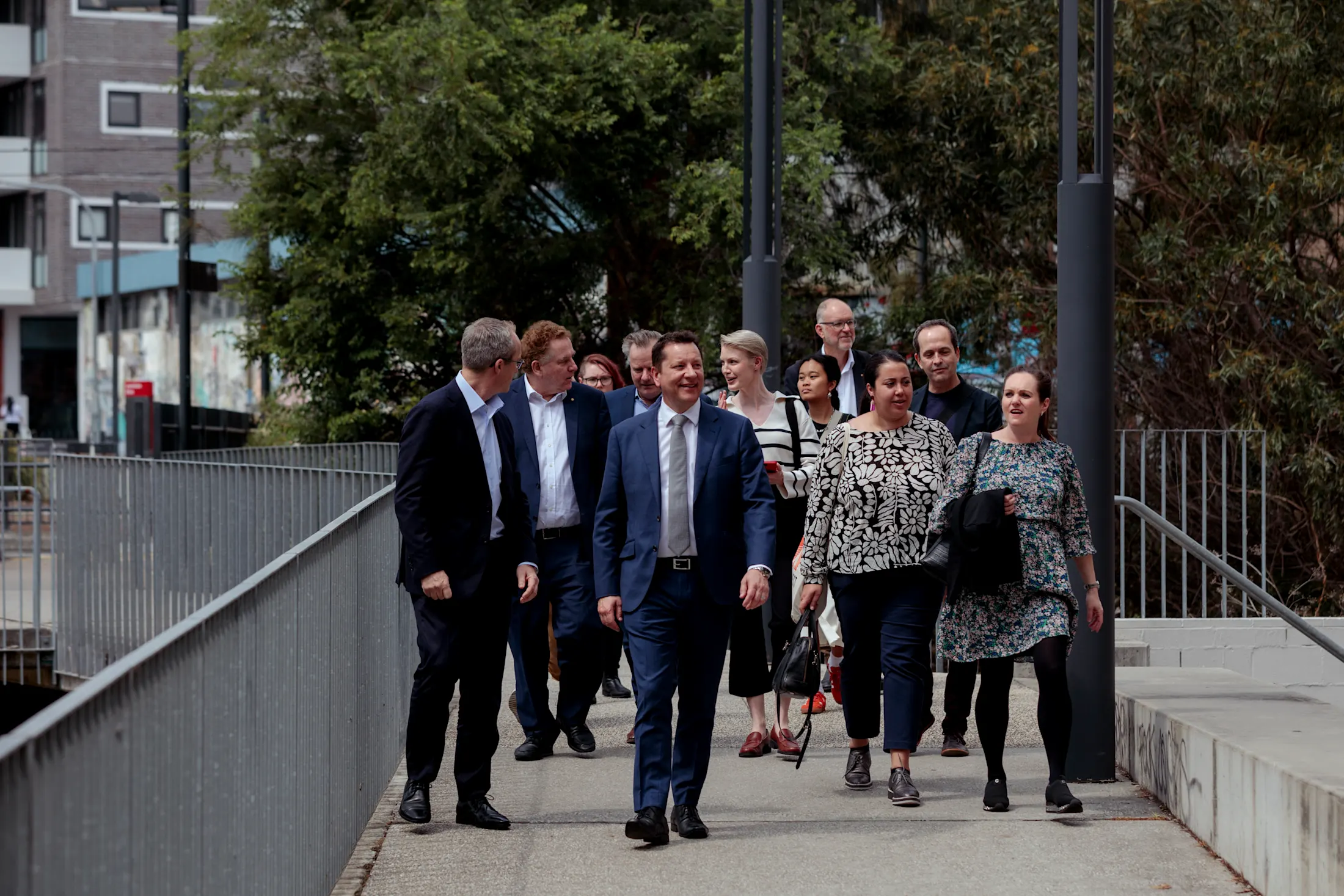
It’s exactly 11:57am and clouds overhead are threatening rain when a group gathers at the small light rail platform at Lewisham West to greet NSW planning minister Paul Scully.
This spot in Sydney’s inner west is surrounded by apartments, some still being built. On one side of the train tracks, and adjacent to a congested main arterial road, is an apartment complex built by Meriton and a construction site.
But the group – a mix of architects, developers, and NIMBY- turned-YIMBYs – heads in the other direction, to what used to be an operational Flour Mill until 2009.
It’s the final stop on Scully’s September tour of three inner-city Sydney apartment developments that have “done density right.” It was organised after the prime minister announced an ambitious national target to build 1.2 million new, well-located homes over five years to boost desperately needed supply and solve Australia’s housing crisis.
The $340 million Flour Mill project, which was finished in 2018, has been a raving success. The master-planned community, which was a joint venture by Daiwa House Australia and EG, sits on a 2.4 hectare former industrial site, with 360 apartments and townhouses spread over 11 separate buildings set around a central plaza and community park.
It has a cafe, a handful of commercial spaces and a small community building designated for regular events like board game nights, singing classes and bicycle workshops, that is run by an offshoot of the developer. Every second Sunday, hundreds of people gather for the markets with live music and stalls selling flowers, fresh food and homewares, set up in the public square.
It’s been a NIMBY success story and Scully, a Wollongong resident who lives in an apartment complex himself, is also impressed. After all, green spaces, private and public amenities, the right proportions relative to the space, and an engaged community are all important elements for the type of apartment development that will lead to happy residents and broader community.
It is, of course, all well and good to venerate these developments as the archetype for what councils, governments and developers should be working towards. But will this help Australia build 1.2 million new homes by 2029?
Developers, economists and academics say it’s an admirable goal but, even though state governments are trying to reform aspects of the planning process, there are five reasons it is unlikely to happen.
1. Councils are not approving enough developments
2. It takes too long for developments to be approved
3. Developers aren’t building enough
4. Inner-city sites left untouched
5. Productivity and labour problems
AUTHOR: INGRID FUARY-WAGNER, CAMPBELL KWAN and GUS McCUBBING
THIS ARTICLE ORIGINALLY FEATURED IN THE AUSTRALIAN FINANCIAL REVIEW on APRIL 12, 2024
extract only. Full article: https://www.afr.com/property/residential/the-five-barriers-to-building-1-2-million-homes-by-2029-20230926-p5e7r1