
By Sarah Mathews, CEO, Little BIG Foundation
This week, the Sydney Morning Herald reported that NSW councils are sitting on a $4.2 billion infrastructure "war chest", developer contributions collected to build the roads, parks, drainage and community facilities that new housing growth demands. More here.
The headline problem, according to the Urban Development Institute of Australia, is that the money isn't being spent fast enough. That's a real issue, and the UDIA is right to raise it.
But there's a quieter problem hiding inside the same system, one that doesn't make headlines because it doesn't show up as an unspent balance in any council ledger. It's the problem of what happens after the building opens.
We fund the building, but we have no system at all for funding what happens inside it.
The Gap the System Can't See
Under the NSW planning framework, developer contributions can fund capital works: the slab, the roof, the carpark, the swing set. What they cannot fund, by law, is programming, staffing, or the operational costs of bringing a community space to life.
The result is predictable, and we see it everywhere. A beautiful new community room sits at ~20% utilisation. A community space opens with a ribbon cutting and is rarely used again.
This isn't a criticism of councils, who are doing their best within a rigid framework. And it isn't a criticism of developers, many of whom genuinely want to see their communities thrive. It's a systems failure, a gap between what the planning system recognises as public benefit (infrastructure) and what communities actually need to flourish (activation).
We see it as the hardware AND the software. Both are required.
What We Know Works
Little BIG Foundation was built on a simple premise: that community connection doesn't happen automatically when you put people in proximity. It has to be made. Humans have to show up, again and again, to create the conditions for belonging.
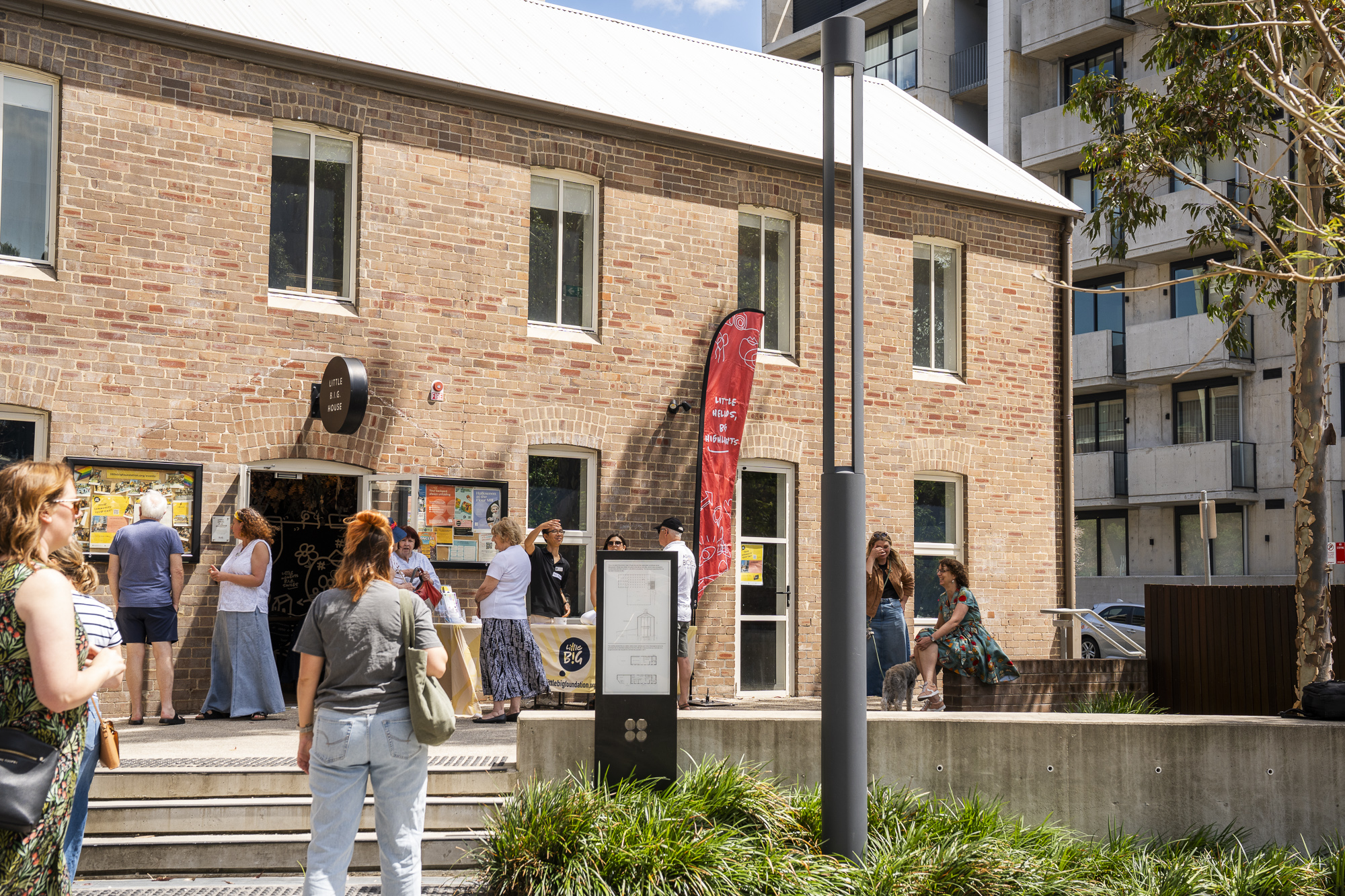
At Little BIG House, our community hub at the Flour Mill of Summer Hill, we operate at approximately 75%+ utilisation, higher than any of the comparable community centres we've benchmarked against in Sydney's Inner West. We do this because of an extraordinary volunteer community.
We are not expensive. We are effective. And the evidence, including our own longitudinal data tracking community connection outcomes from 2022 to 2025 shows that well-activated community spaces deliver measurable reductions in social isolation, kindness and familiarity.
The difference between a space that thrives and one that sits empty isn't just the building. It's the activation.
A Different Kind of Conversation
Little BIG Foundation has been in conversation with NSW government, local councils, and property developers about what a small but meaningful reform in this space could look like.
The planning system already recognises open space, affordable housing, and transport infrastructure as community benefits worth investing in. We think there's a strong case for it to recognise sustained social activation in the same way, not as an afterthought, but as a legitimate part of what makes a residential development a genuine community.
The principle: that developers who choose to invest in long-term community activation should have a reason to do so, and that the planning system should make that easier, not harder.
We're at an early stage of this conversation, and we're genuinely interested in getting it right. That means listening as much as advocating.
The SMH article quotes UDIA NSW chief executive Stuart Ayres: "A system that accumulates infrastructure funds rather than building infrastructure is a broken one and must change."
We agree. And we'd like to add: a system that builds infrastructure without activating it is also broken, just in a way that's harder to measure but seriously felt.