
What a resident survey taught us about the hidden power of public space activation — and why the smallest design decisions carry the greatest social weight.
Loneliness isn't solved by proximity. You can live in a dense urban precinct, share a courtyard with dozens of neighbours, and still feel profoundly alone. What closes the gap between being near people and actually feeling connected is far subtler, and far more designable, than we often assume.
At Little BIG Foundation, our work is built on a simple premise: that the right conditions for connection can be deliberately created. Not manufactured or forced, but quietly, carefully enabled.
We are pleased to collaborate with the Flour Mill Business Collective on a recent resident survey at the Flour Mill of Summer Hill which gave us a vivid reminder of just how true that is, and how much hinges on the details.
What the data told us
The Flour Mill plaza in Summer Hill's Inner West is a thriving community space. When we surveyed Flour Mill residents, the picture was genuinely heartening.
- 55% of residents use the plaza to sit and relax
- 42% come specifically to meet neighbours and friends
- 78% are doing this multiple times per week
People were using this space, returning to it, building routine around it. By any measure, that's a community activation success story.
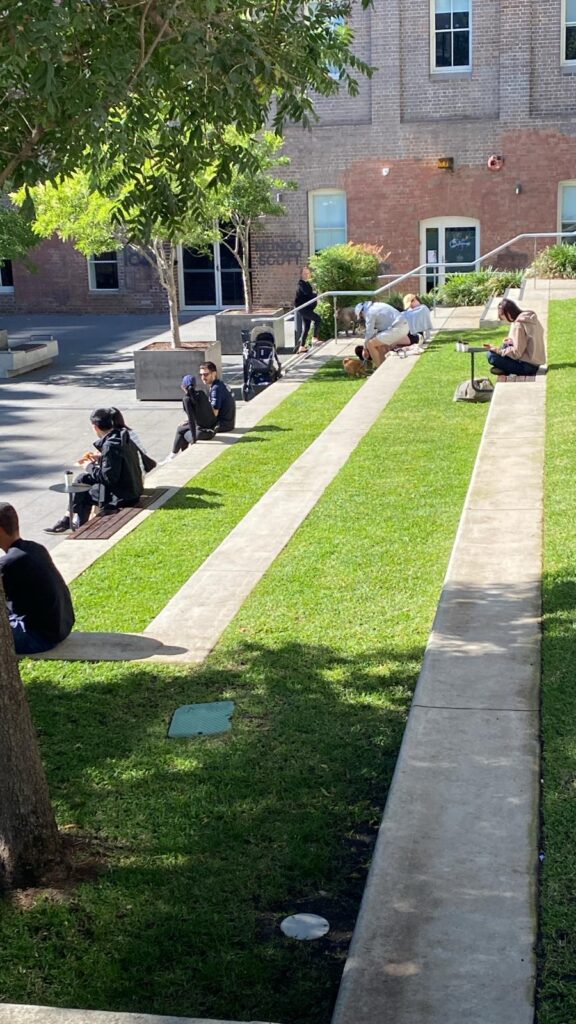
But alongside those numbers came something else: 44.5% of residents said they wanted more seating. We counted 23 dedicated spots across approximately 3,000sqm, an objectively generous provision, before accounting for the plaza's tiered amphitheatre steps where almost any edge can become a seat and the table and chairs provided at four food and beverage venues. So we sat with the apparent contradiction and asked: what were people actually telling us?
They weren't counting chairs. They were describing how the space made them feel.
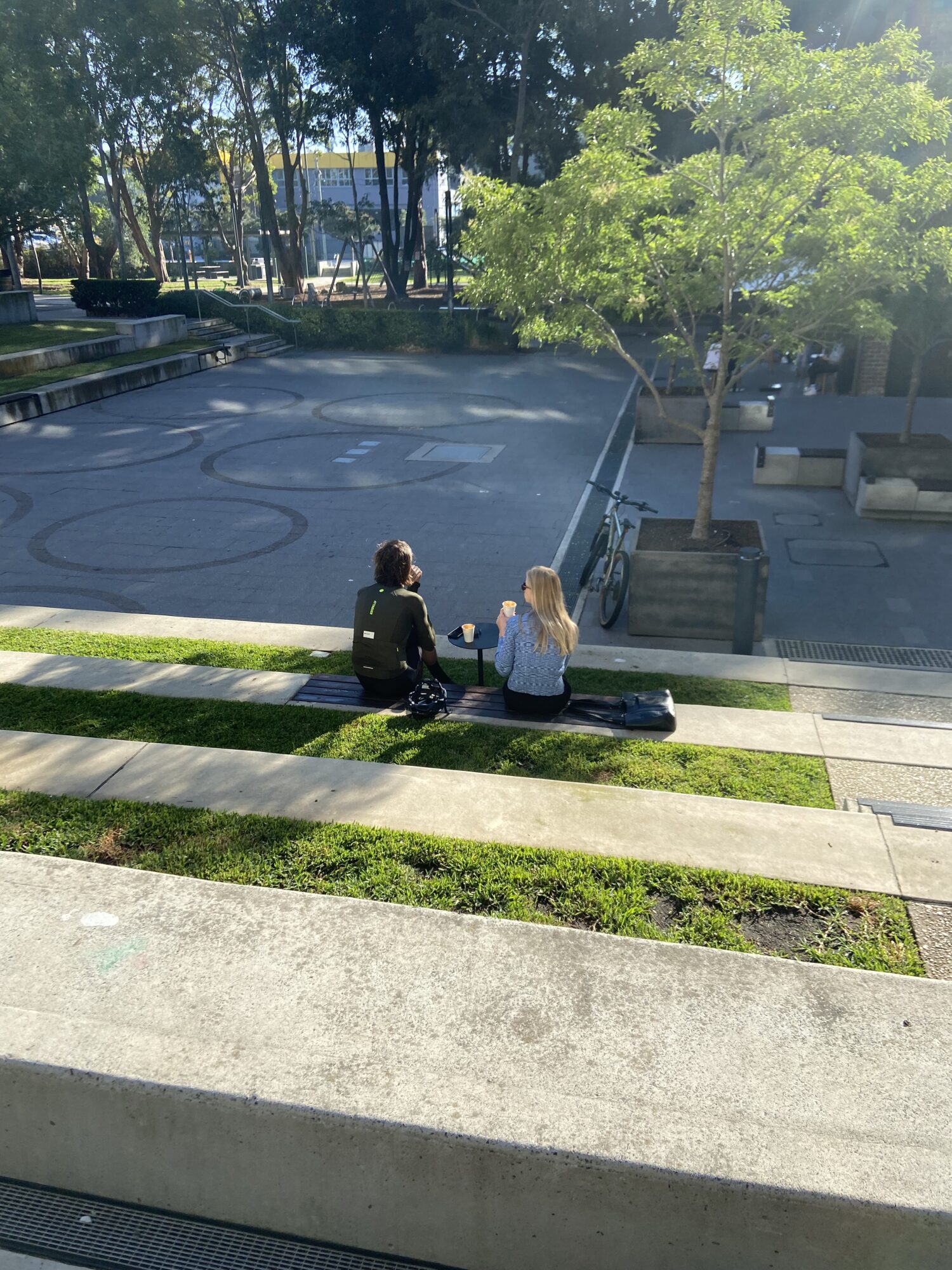
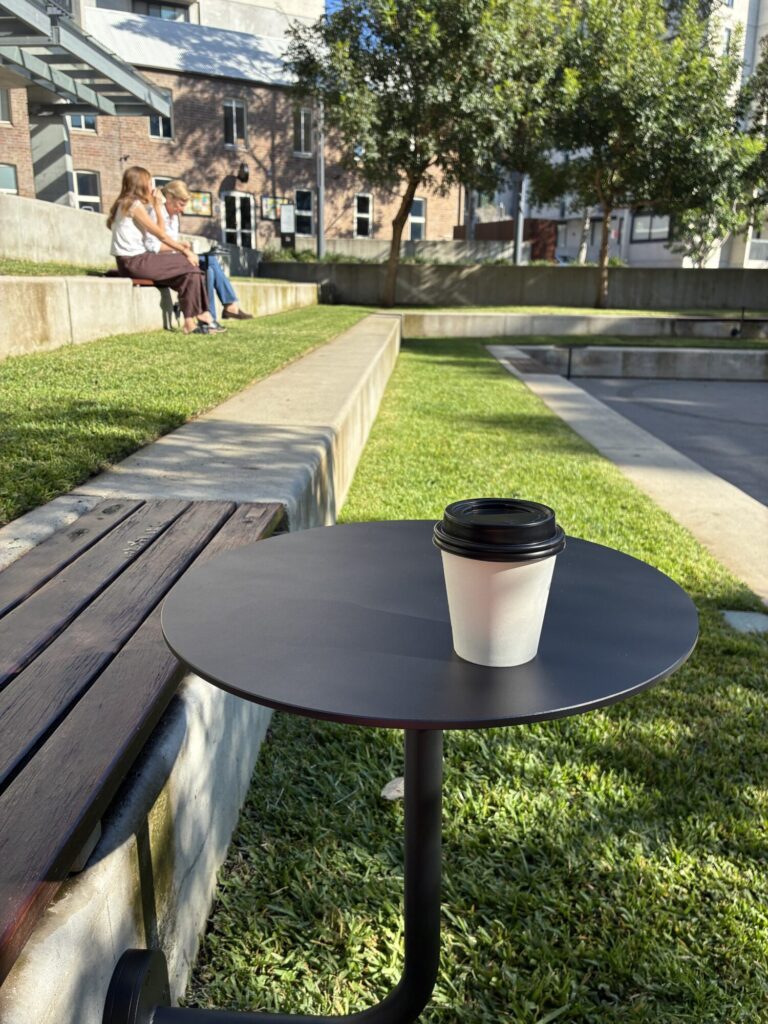
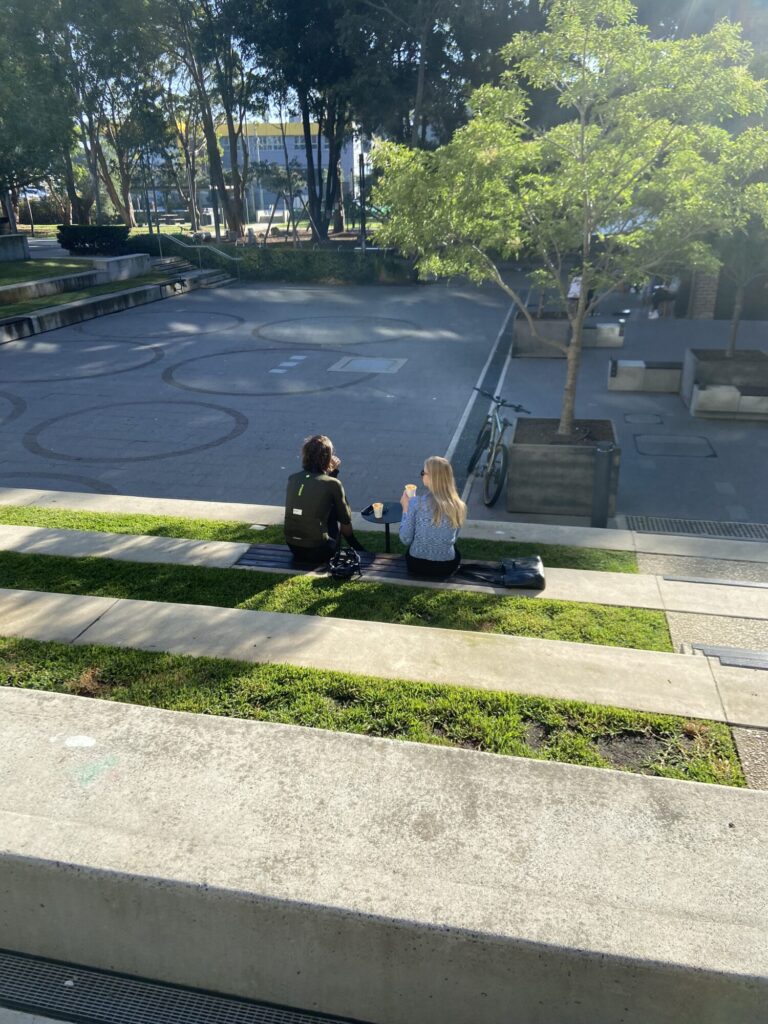
They wanted to know, just by looking, that it was okay to stay. They wanted somewhere to put their coffee down, to linger after the weekend markets, to settle into a conversation without feeling like they were occupying space that wasn't quite theirs. They wanted to feel invited.
The science of feeling welcome
This gap, between a surface that exists and a surface that signals welcome, turns out to be one of the most consequential distinctions in placemaking. And it has direct implications for loneliness.
Loneliness research consistently tells us that casual, repeated contact with others, what sociologists call "weak ties", plays a significant protective role against isolation. Not always deep friendship, but the neighbour you nod to, the familiar face at the coffee cart, the person you end up chatting to because you're both sitting at the same table in the sun. These micro-connections accumulate into something meaningful: a felt sense of belonging.
The design of public space either enables or forecloses these moments. And the research on how is striking:
- Furniture creates permission. William H. Whyte's landmark study of New York plazas found that an external stimulus — a table, a café setup — can prompt strangers to interact. Without it, people remain physically present but psychologically closed off. The object signals that connection here is welcome.
- Arrangement shapes interaction. Ahmadi & Toghyani (2021) found that the spatial layout of urban furniture significantly affects not just whether people sit, but how long they stay and whether they talk to each other. The quality and duration of social contact changes with the configuration. (Urban Design International, 2021)
- Variety — not quantity — is the key. Research mapping seating across multiple public spaces found that variety of seating options dramatically increases dwell time. Grouped seating encourages social use. Isolated benches see brief, solitary visits. (Project for Public Spaces)
- Weak ties reduce loneliness. Longitudinal studies including work by Holt-Lunstad et al. show that social integration — even at a low level — is a significant predictor of wellbeing. Place-based activation that creates repeated incidental contact builds exactly this kind of protective social fabric. (Perspectives on Psychological Science, 2015)
Activation is the intervention
This is why Little BIG Foundation's model centres on activation. A beautiful plaza with generous seating is a necessary condition, but it is not sufficient. What transforms a space from somewhere people pass through to somewhere people belong is the layering of signals, design + programming (the hardware and the software) that says: linger here, you are welcome, connection is possible.
A table is not just a table. It is a micro-intervention against loneliness. It creates a reason to stop, a surface to share, a social grammar that even strangers can read. Put it in the sun, add the possibility of a coffee, and you have the conditions for the kind of spontaneous, repeated, low-stakes contact that quietly stitches community together.
The Flour Mill plaza is already a place people return to, multiple times a week, for connection. Our job is to keep listening to what the community is really telling us, and to keep designing spaces that meet them with an open invitation.
References:
Whyte, W.H. (1980) The Social Life of Small Urban Spaces. Conservation Foundation.
Gehl, J. (2011) Life Between Buildings. Island Press.
Ahmadi & Toghyani (2021) Urban Design International.
Holt-Lunstad, J. et al. (2015) Social relationships and mortality risk. Perspectives on Psychological Science.
Project for Public Spaces, pps.org.
Flour Mill Resident Survey | August 2025 | Collected by the Little BIG Foundation
Flour Mill Place Audit | February 2026 | Collected by Inhabit Place