
At a time when we believe loneliness and social disconnection are rising across Australia, the 2025 Little BIG House Social Connection Report offers both hope and a clear-eyed reminder of the work still ahead.
The findings paint a picture of a community that is choosing connection, not accidentally, but intentionally, through shared spaces, repeated encounters and a culture that values participation. At the same time, the data reminds us that loneliness remains a persistent and growing challenge, even in places doing many things well.
The good news: connection is deepening
Across almost every measure of social connection, the Little BIG House community continues to strengthen.
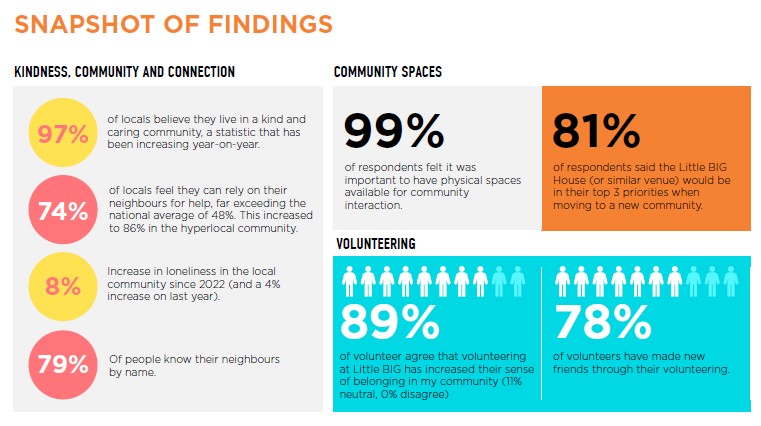
More people than ever know their neighbours by name, a simple but powerful marker of belonging. Among residents closest to the Little BIG House, this figure has almost doubled since 2022, now sitting well above the national average. Satisfaction with community interaction has followed a similar trajectory, with the vast majority of respondents reporting they are happy with the level of connection in their daily lives.
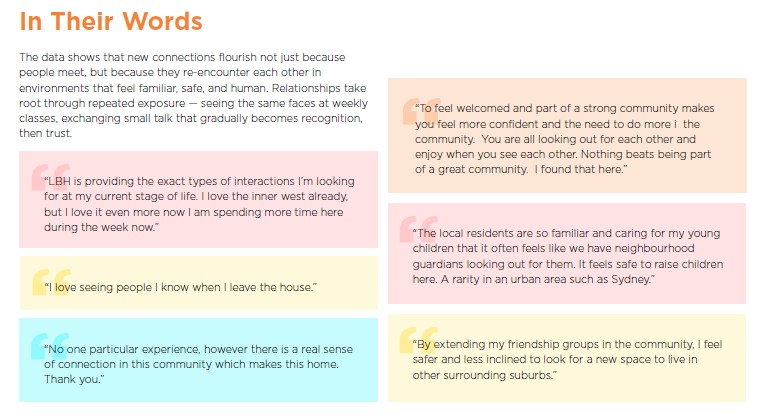
Kindness, too, stands out as a defining feature of the community. Nearly all respondents believe they live in a kind and caring place, and a growing number say they can rely on neighbours for help when they need it; whether that’s groceries during illness, checking in during hard times, or the quiet everyday gestures that make people feel seen. The stories shared in the report bring these statistics to life, revealing a web of practical, human support that extends far beyond organised programs.
Regular, in-person social contact remains strong. Compared to national benchmarks, people in and around the Little BIG House are far more likely to see friends or family weekly, suggesting that social connection here is not an “extra” but embedded into everyday life.
The role of place: why spaces matter
One of the clearest messages from the report is the near-universal value placed on physical community spaces. Almost all respondents say it is important to have places designed for interaction, and the Little BIG House (or a similar venue) consistently ranks among the top priorities when people think about where they want to live.
For many, the connections formed through Little BIG actively influence decisions about staying in the area. This sense of attachment, to people as much as to place, highlights how social infrastructure can shape not just wellbeing, but long-term commitment to a community.
Placemaking events like markets, festivals and celebrations play a critical role here. They offer low-pressure entry points for connection, drawing people out of their homes and into shared experiences that feel welcoming, familiar and human.
Volunteering: a powerful pathway into belonging
Volunteering continues to emerge as one of the strongest drivers of connection. Almost nine in ten volunteers report an increased sense of belonging, and many say they’ve formed new friendships through their involvement.
What’s striking is how often volunteers describe gaining more than they give. The data suggests that participation, contribution and shared responsibility don’t just support the community, they actively strengthen the wellbeing of those who step forward.
The harder truth: loneliness hasn’t disappeared
Despite these strong positives, the report doesn’t shy away from a sobering reality: loneliness is still rising at a broader local and national level.
While people living closest to Little BIG House report lower levels of loneliness than the national average, a promising sign, overall rates have increased since 2022. Even within a highly connected environment, loneliness has not been eliminated. This reinforces an important truth: social connection is protective, but it is not a silver bullet.
The data also shows some fluctuation within the hyperlocal community, with certain indicators plateauing or dipping slightly in 2025. Rather than signalling failure, these shifts highlight the dynamic nature of communities and the need for continual adaptation, renewal and care.
What this means moving forward
Taken together, the 2025 Social Connection Report tells a nuanced story.
It shows that when connection is designed with intention, through accessible spaces, regular activities, welcoming hosts and opportunities to contribute, relationships grow. Trust builds. Kindness becomes visible. People feel safer, more supported and more inclined to stay.
At the same time, the findings remind us that loneliness is a systemic issue, shaped by broader social, economic and cultural forces. Community spaces like the Little BIG House don’t “solve” loneliness, but they do create the conditions where people are less likely to face it alone.
The work, then, is ongoing. It’s about continuing to listen, to evolve programs, to support volunteers, and to protect the social infrastructure that makes connection possible in the first place.
Because the data is clear on one thing: loneliness is not inevitable, but connection doesn’t happen by accident.