
Loneliness is one of the defining social and health challenges of our time, and increasingly, the evidence shows that the built environment is part of the problem, and part of the solution.
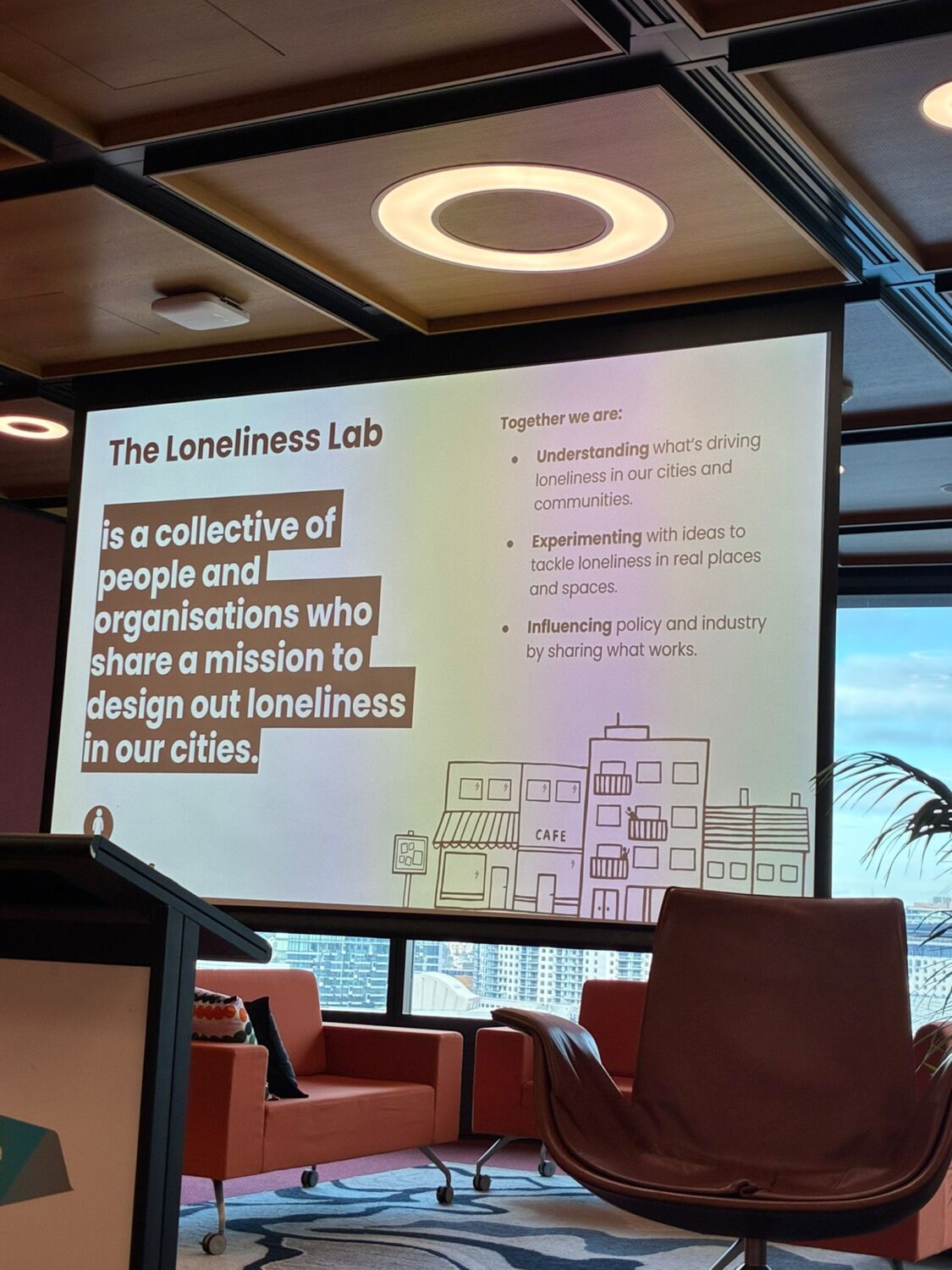
The Little BIG Foundation was proud to join the launch the Loneliness Lab Australia, a new cross-sector collective bringing together government, developers, planners, architects, researchers and community organisations around a single shared question: how might we design loneliness out of our cities?
Why this matters
The World Health Organisation now recognises loneliness as a global public health concern, with disconnection linked to an estimated 870,000 deaths a year worldwide, and a toll on health that rivals smoking and obesity. Here at home, the Ending Loneliness Together State of the Nation Report found one in three Australians report feeling lonely on a regular basis, and it's costing the economy an estimated $2.7 billion a year. Yet despite a growing evidence base, Australia still has no national strategy treating loneliness with the urgency of a public health priority.
What the evidence makes clear is that loneliness isn't simply a personal circumstance, it's shaped by the systems, streets, homes and shared spaces we build.
A landmark University of Sydney review of 57 international studies found that housing design, street layout, public space, transport and green space all influence whether people can connect. A 2026 Monash University study, analysing 22 years of data across 335 regions, found loneliness concentrates wherever economic hardship meets a lack of community infrastructure.
The 2025 Australian Unity Wellbeing Index found the highest-loneliness electorates in the country sit in our biggest capital cities, skewing younger, less economically secure, and more culturally and linguistically diverse than the national average.
The 2025 NSW Parliamentary Inquiry went further, warning against the creation of "lonelygenic environments" and calling for equitable access to third spaces, green space and transport. In short: where and how we build affects how lonely people feel.
The hardware, software and code of connection
The position paper frames the built environment through three interlocking lenses:
- Hardware — the physical spaces themselves: homes, streets, parks, offices, community centres
- Software — the programming that activates those spaces: events, services, and the people who bring them to life
- Code — the policies and standards that incentivise developments which bring people together, and discourage those that entrench isolation
Its central point is that none of these works in isolation. At Little BIG, we know too well that a beautifully designed public space with no activation sits empty. A brilliant community program with nowhere suitable to run it can't scale. And without policy backing, both remain fragile, one-off efforts rather than the new normal.
Real change requires all three aligned — hardware, software and code moving together.
Where Little BIG fits in
This is exactly the space Little BIG works in every day. Our CEO Sarah Mathews and Volunteer Leadership Committee member Brenda Lin shared what we've learned on the ground at Little BIG House, demonstrating that good design is only half the story. Spaces don't build community on their own; they need the "software" of activation, facilitation and everyday care alongside them.
That's the thinking behind everything we do: creating the pathways, infrastructure, policy settings and environments that make it easier, not harder, for people to be kind to one another, to support each other, and for social outcomes to actually get delivered, not just designed on paper.
The workshop reinforced what we already know from lived experience: infrastructure alone isn't enough. Genuine connection needs the right physical spaces (hardware), the right programs and people activating them (software), and the right policies and funding models backing it all up (code).
Real, lasting change happens only when all three are aligned, and when the people closest to the ground, including volunteers, placemakers and local leaders are in the room shaping the answer.
What's next
The Ignition Workshop surfaced six priority areas where coordinated national action is needed most:
- Better design — treating the built environment as an underused lever for connection, not an afterthought
- Young people — building responses that match the depth of what younger Australians are actually experiencing
- Life transitions — designing for the moments (retirement, migration, parenthood, ageing) when social networks are most likely to break down
- Community engagement — making genuine co-design standard practice, not an optional extra
- Policy and systems — establishing clear ownership and accountability, given loneliness currently has no national strategy, ministerial portfolio, or policy metric behind it
- Metrics — making social connection measurable, so it can be funded and acted on rather than treated as an invisible cost
To move on these, the Lab is now formalising a coalition of partners across three roles: Foundation partners, who anchor the Lab with direction, funding and networks; Action partners, who put ideas into practice in real-world settings and build the evidence base; and Influence partners, who help embed learnings into policy and shift public and industry narratives. No single organisation plays all three roles.
Little BIG is committed to playing our part as an Action partner: contributing our on-the-ground evidence from Little BIG House, testing new approaches, and helping translate insight into action alongside our fellow partners across the coalition.
Thank you to PATHMAKER and Lendlease for convening such an important conversation, and to everyone in the room; researchers, developers, architects and community leaders alike, who showed up ready to do the hard work of building more connected places.
We look forward to seeing where these conversations lead, and to continuing to inspire communities to connect better.
Learn more about the Loneliness Lab Australia at lonelinesslab.au
Read the full report at https://lonelinesslab.au/loneliness-lab-position-paper-2026-online