
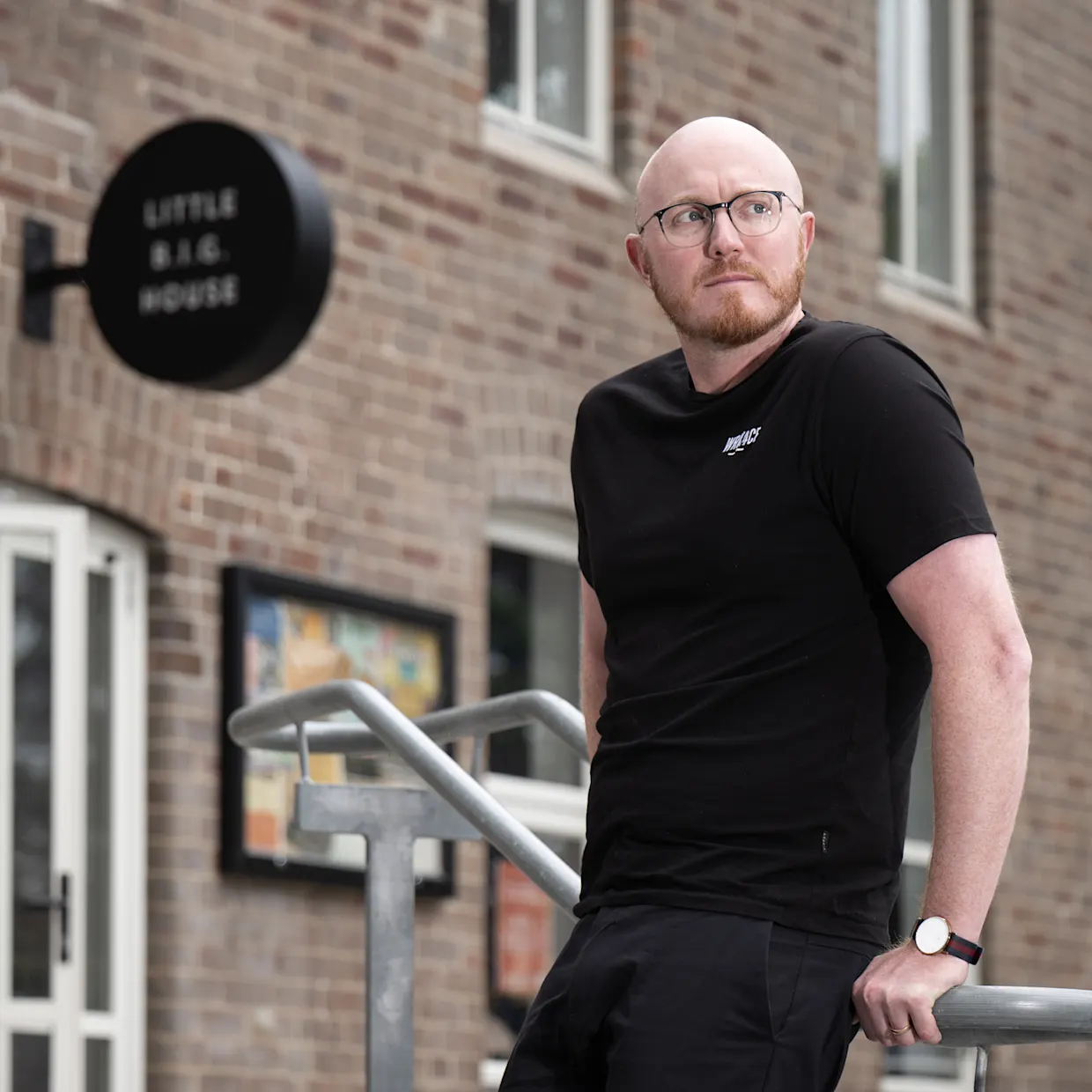
Sam Freeman knows only too well that making friends as an adult isn’t as easy as it was at school. It’s something the 37-year-old battled with in 2023 when he moved to Sydney from India, where he and his wife had worked for 10 years.
With so many people locked into established friendship groups and seemingly closed off to outsiders, getting that first toe in the door felt frustratingly elusive. Freeman hadn’t gone to a school that Sydneysiders recognised, had no kids at the time to help him form a bridge with parents and, because he grew up in Brisbane, he was building his network from scratch.
“It was just as the weather was becoming quite cold, and [with] very little network around us and very little support … I really struggled to make any connection, to meet anybody or to do anything social,” Freeman says.
And so, like an estimated 2.3 million other Australian men that year, he was struck by loneliness – that unsettling and often frustrating feeling of sadness and disconnectedness that can occur even when we’re surrounded by other people.
It’s a feeling that peaks in men in their 40s, before declining once they turn 50 and rising again at 70, according to an analysis of longitudinal Australian survey data published last year in the journal BMC Public Health.
But while research shows loneliness peaks for men in middle age and has been increasing across the board since 2009, the evidence to support a “male loneliness epidemic” is perhaps not as strong you may have thought.
As men climb the corporate ladder, get busy raising families or pour hours each week into improving their fitness, they can often lose sight of the value of close friendships and inadvertently let them wither and die.
While some become recluses who rely on their partners to organise their social lives, others keep in regular contact with other men through WhatsApp chat groups and visits to the pub, but still feel lonely because the connections are too superficial to sustain the type of conversations that make them feel heard.
Major life transitions, like Freeman’s international relocation, often play a role, too, and perhaps more so for men than for women. Research by British anthropologist Robin Dunbar in 2017 found that male friendships operate according to the principle of “out of sight out of mind”, whereas female friendships can be sustained using long phone conversations to bridge physical distances.
“What determined whether [friendships] survived with girls was whether they made effort to talk more to each other on the phone,” Dunbar told The Guardian at the time. But boys’ friendships only survived if they did stuff together. “Going to a football match, going to the pub for a drink, playing five-a-side [soccer]. They had to make the effort. It was a very striking sex difference.”
Dunbar wasn’t the first to make this point. In 1982, an oft-cited paper published in the journal Sex Roles found that while female friendships emphasised emotional sharing and talking, male friendships emphasised activities and doing things together.
Suffice to say, then, that we’ve known about the inherent weaknesses of male friendships for a long time. And yet, it wasn’t until after the pandemic that the idea of a “male loneliness epidemic” became deeply entrenched in the zeitgeist.
The forced isolation of the COVID-19 lockdowns underscored the crucial importance of meaningful connection and helped to de-stigmatise loneliness, which suddenly became not just a topic discussed only in the context of mental health, but something that just about anyone could experience, and at any time in their lives.
What’s more, we reasoned, our modern-day addiction to screens and technology was making our loneliness so much worse. Instead of choosing the sometimes tricky task of bumbling through awkward social encounters to form new real-life friendships, social media and Netflix were encouraging us to stay home instead. And the data does indeed show that we socialise with friends and relatives outside our household less frequently than we did 10 or 20 years ago.
Amid all this, the World Health Organisation in 2023 declared loneliness “a pressing health threat” and named then-US surgeon general Vivek Murthy the co-chair of a new commission to tackle it. That year, Murthy resurfaced a more-than-decade-old statistic that loneliness contributed to early death about as much as smoking up to 15 cigarettes a day did.
And so, when this writer was commissioned to write a story about male loneliness, he fully expected rates of loneliness to be at all-time highs in Australia. But they weren’t. The research paints a more complicated picture. That is partly because loneliness, a subjective feeling of distress caused by a lack of meaningful social connections, differs from social isolation, which describes when somebody has objectively few social relationships.
Article continues. Read here: https://www.afr.com/life-and-luxury/health-and-wellness/what-we-get-wrong-about-male-loneliness-20251124-p5nhtf
AUTHOR: EUAN BLACK
THIS ARTICLE ORIGINALLY FEATURED IN THE AUSTRALIAN FINANCIAL REVIEW on DECEMBER 12, 2025